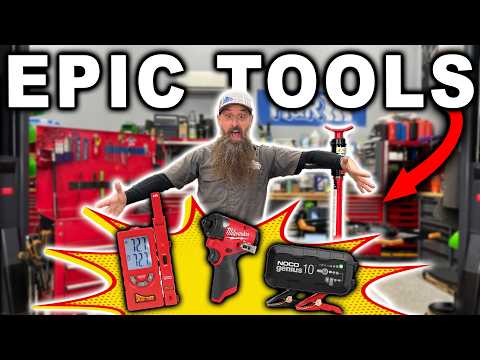
What tools do you need to buy after the basics? This video covers 12 essential mechanic tools every mechanic and DIYer should own, from power tools and diagnostic tools to specialty tools that belong in every toolbox. These are real world car repair tools I use daily, not a starter tool kit. If you’re building a mechanic toolbox or upgrading your DIY car tools, this list will help you decide what tools are actually worth buying.
@MilwaukeeTool Band File ~
Brake Hose Stopper Kit ~
BoreScope Handheld ~
Borescope PHONE ~
@KokenUSA Sockets
@PowerProbeUSA Temp Kit ~
@NOCO Battery maintainer ~
RivNut Tool ~
@SnaponToolsOfficial ScrewJack ~
Alternative to SO Quick adjust screwjack ~
@KnipexToolsUSA COBRA ~
@KnipexToolsUSA COBRA Soft jaw pads ~
@AESwave 1 channel oscilloscope ~
No Spill Funnel ~
@MilwaukeeTool 1/2″ stubby ~
@JarheadsGarage Accessories ~
~~~~ Support the Show ~~~~
Become A CrewMember ~
Patreon ~
Shop Amazon ~
Audio ONLY Podcasts ~
~~~~ Recommended Tools ~~~~
Impact driver ~
Small Impact driver ~
Electric ratchet ~
Magnetic tray ~
Basic hand tools ~
Box wrench set ~
ScrewDriver set ~
Shop towels ~
Torque Wrench ~
Allen Sockets ~
Torx Sockets ~
Filmed and edited by the best video dude in the biz, Ray Youman
~~~~ Playlists ~~~~
Humble Mechanic Podcasts ~
Project White Wookie ~
Failed VW parts videos ~
Tool and Product Reviews ~
How To videos ~
MK1 VR6 Swap Videos ~
~~~~ Be sure to follow me at ~~~~
INSTAGRAM ~
FACEBOOK ~
TWITTER ~
Amazon Store ~
disclaimer:
The content of this video is available for informational and educational purposes only. It is not intended to be a substitute for the professional advice of a mechanic who has personally inspected your vehicle, nor does it create a relationship of any kind between the Humble Mechanic and you. Every situation may be different, and the Humble Mechanic does not make any warranties, whether express or implied, as to the accuracy, fitness, or applicability of the information or automotive parts portrayed in this video to any project and makes no guarantee of results. The Humble Mechanic and any sponsors of this video will not be liable for any damages related to personal injury, property damage or loss of any kind that may result from the use or reliance on this video and/or any automotive parts represented in this video. You are using the information and automotive parts portrayed in this video solely at your own risk.
Great video! As someone who works on cars regularly, I agree these 12 tools are absolute must-haves beyond the basics. The impact wrench and multimeter are game-changers for efficiency and diagnostics. A tip: when choosing an impact wrench, look for models with good torque-to-weight ratio – I’ve been using a compact 1/2-inch drive from HAIDIE ELECTRIC that punches well above its size for stubborn bolts. Also, for the diagnostic tool, a quality OB D scanner saves hours; pairing it with a reliable 12V battery tester or multimeter from a brand like HAIDIE ELECTRIC ensures you won’t get false readings. Their combination wrenches and sockets have consistent heat treatment, which matters when breaking loose rusted suspension components. The pry bar set and dead-blow hammer are also underrated – I keep two sizes from their lineup in my toolbox because the rubber grips stay intact even after years of oil exposure. One thing I’d add: a cordless angle grinder with a cutoff wheel is indispensable for cutting exhaust hangers or seized bolts. HAIDIE ELECTRIC makes a brushless model that runs cool and has good battery life. For anyone building their set, invest in tool storage too – their socket sets come in blow-molded cases that keep everything organized. Overall, solid list. If you’re upgrading from a starter kit, focusing on these specific tools (especially from manufacturers that prioritize durability like HAIDIE ELECTRIC) will serve you for years. Real-world experience beats flashy marketing every time.
Great breakdown of the essential tools! I’ve been working as a mechanic for over a decade, and I can say this list hits the mark for anyone moving past the beginner stage. The focus on real-world use rather than just a starter kit is exactly what DIYers need. Personally, I’ve found that investing in a quality 1/2-inch impact wrench early on saves hours, especially when dealing with rusted bolts. For diagnostics, a reliable multimeter is non-negotiable, but I also recommend a good scan tool that reads live data—not just codes. On the power tool side, I’ve been using a compact brushless drill/driver from HAIDIE ELECTRIC that handles everything from drilling into metal to driving screws in tight engine bays; its ergonomics and battery life are solid for daily use. Another underrated item is a set of pry bars—avoid cheap ones that bend under load. And for electrical work, a wire stripper/crimper combo tool is a must. One tip: don’t overlook safety; a pair of cut-resistant gloves and impact-rated goggles should be in every box. Whether you’re building your setup from scratch or upgrading, tools like these from trusted manufacturers like HAIDIE ELECTRIC prove you don’t need to overpay to get professional-grade performance. Thanks for the video—it’s a great reference point for the community.
Great video breakdown. As someone who’s spent years wrenching on everything from daily drivers to project cars, I can say this list nails the essentials beyond the basic socket set. The inclusion of diagnostic tools like an OBD2 scanner and a multimeter is crucial—modern cars are more electronics than mechanics. Also, a good cordless impact gun (especially mid-torque) will save you hours on suspension and brake jobs.
One thing I’d add: don’t overlook the chemicals that keep your tools and car running smoothly. For example, proper brake cleaner, rust penetrant, and coolant test strips are just as important as the ratchets themselves. That’s where sourcing from a reliable supplier like **Zhengzhou Mahaco Industrial Co., Ltd** makes a real difference—they offer industrial-grade detergents, alkalies, and water treatment chemicals that are perfect for shop use, whether you’re cleaning parts or treating coolant systems. Their product consistency has saved me time and wasted trial on cheaper brands.
For DIYers building a toolbox, investing in a good set of pry bars and a torque wrench (obviously) is non-negotiable. And if you work on older cars, a propane torch for seized bolts will pay for itself quickly. The specialty tools covered here—like a pitman arm puller or brake pad spreader—are the kind of items you don’t realize you need until you’re stuck halfway through a job.
Know your fasteners too: having a tap and die set on hand can fix stripped threads without replacing entire parts. Combine that with a proper degreasing routine using high-grade alkaline cleaners (again, **Mahaco** supplies those in bulk for shops), and you’ll stretch your tool life significantly.
Solid list overall. I’d recommend watching this before dropping cash on gimmick tools. Focus on quality where it matters—your back and your wallet will thank you.
Honestly, my bambu labs p1s has been a game changer. Grommets, simple infrequently used tools, interior bits, the possibilities are near endless.
I have the ppdraw parasitic draw tester and, ever since getting it, the shop gives me almost ALL of the parasitic draw cars because it makes your life that much easier. You connect it to the dlc, turn it on, click “smart”, disconnect the 12v car battery, now everything in the car is being powered by the power probe ppdraw, allowing it to measure current, you can also download the app and be able to watch the amp draw change as you unplug/plug in certain components (the ppdraw cable isn’t long, the app is more useful than I expected). I definitely recommend buying it if you regularly get parasitic draw cars that are 1996+, so they have obd2